


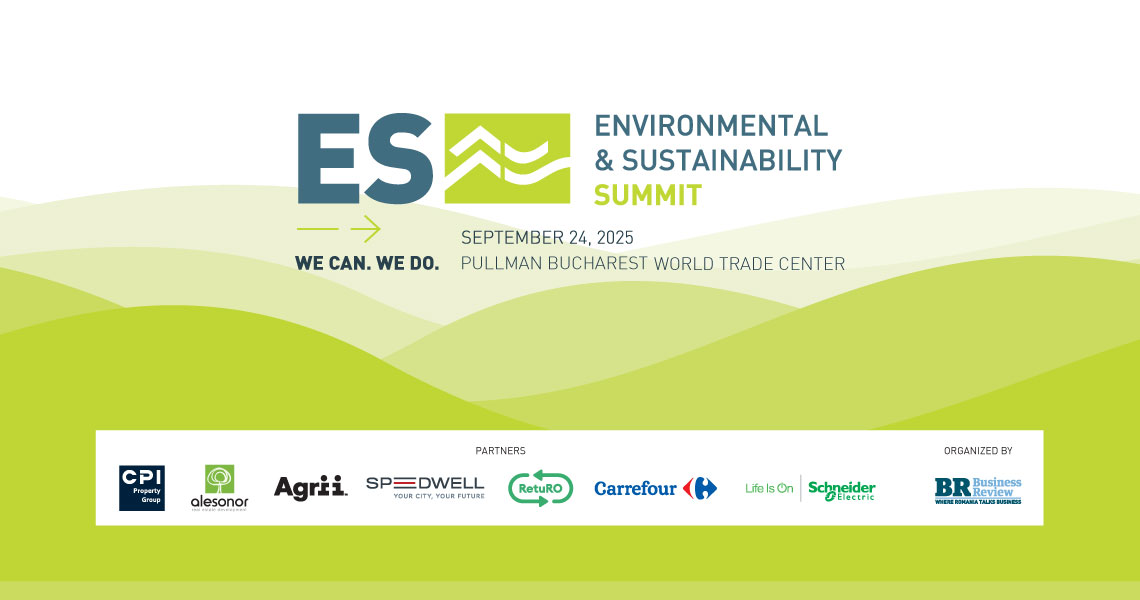
Sustainability is no longer a distant goal or a set of principles to be gradually adopted; it has become a business model in its own right. Many companies have already integrated sustainability into their supply chains, and annual reporting has become standard practice for large firms. Business Review’s Environmental & Sustainability Summit 2025 takes place on 24 September at the Pullman Hotel in Bucharest, bringing together leading voices from business, government, finance, and civil society to address the defining challenge of our time: building a sustainable, resilient economy and society.
In effect, regardless of how legislation on sustainability evolves, businesses are already using it to cut costs and strengthen long-term resilience. “At Speedwell, sustainability is no longer a mere add-on; it is our foundation. From the earliest design phases, all our developments aim for top-tier certifications such as BREEAM, WELL or Green Homes,” says Yannick Van de Parre, Country Manager for Romania at Speedwell. “Since 2023, none of our new projects have been connected to gas; instead, we are implementing heat pumps, photovoltaic systems, and other renewable technologies to pave the way toward a low-carbon future.”
 An example of a new sustainably built project comes from Vastint. “In May this year, we officially launched the second phase of Timpuri Noi Square, an urban regeneration project of major importance, for which we aim to achieve the highest level of green certification — more than 100 points in LEED Platinum, continuing our tradition of promoting sustainability across our portfolio,” says Antoniu Panait, Managing Director at Vastint Romania. “This level is not mandatory and is not imposed on us by anyone. From our very first project in Romania, sustainability and urban regeneration have been key pillars of our strategy. Our buildings have therefore been designed and constructed with a focus on employee health and well-being, incorporating advanced safety and health standards, improved ventilation systems, antibacterial design solutions, and sports facilities.”


In many cases, adopting sustainability principles has reshaped not only business models and financial returns, but also the impact companies have on people, the environment, and local communities. ”In Cluj-Napoca, RIVUS project (a EUR 500-plus million investment), signed by the Dutch architects at UNStudio, transforms a former industrial platform into a vibrant, green, and connected urban space, integrated into the urban fabric,” says Dan Chelaru, Group Sustainability Officer IULIUS. ”This year, RIVUS obtained the largest loan granted to a new real-estate development in Romania. This is a green syndicated loan, secured by the achievement of and compliance with the LEED Platinum and EDGE Advanced sustainability standards, which cover the entire development-operation-refinancing cycle. The loan adds up to approximately EUR 400 million and is a syndicated financing granted by four loan institutions: Erste Bank, BCR, EBRD, and BRD.”

 “For us, sustainability is not just a goal but a way of building and being. At CPI, we strive through specific initiatives to inspire our team and clients to adopt a more sustainable lifestyle,” says Diana Gruianu, Marketing Manager Office at CPI Romania. “In our office, as well as across our entire portfolio, we aim to create a responsible ecosystem that includes recycling hubs, electric vehicle charging stations, personal and rental bicycle facilities, optimised water and energy use, expanded green areas, and flexible, inclusive layouts designed for the well-being of tenants and employees. Every year, we also take part in Let’s Do It, Romania!, the country’s largest environmental volunteer movement, helping to clean up waste across different areas.”
 “Sustainability has always been a core principle, not a regulatory constraint. We adopted the nZEB standard early and took it even further. Amber Forest is the first residential development in Europe to achieve the LEED v4.1 Communities: Plan and Design Platinum certification,” says Alex Skouras, CoFounder and Managing Partner at Alesonor. “Features like energy efficiency, smart home technologies and green spaces are no longer extras or niche. They are things buyers now expect as standard. Building at this level, across an entire community rather than just at house level, does involve higher upfront costs, but we see it as a long-term investment. It adds value both to the property itself, as an asset, and to the daily life of residents through better comfort, cleaner air and more efficient homes.”
SUSTAINABILITY IN RETAIL

In the retail sector, business transformation has been driven both by the introduction of the return guarantee system for plastic, glass, and metal packaging as well as by the integration of social and environmental standards. “For Auchan Romania, sustainability is a priority, and with the adoption of our new ESG strategy it has become a fundamental pillar of the business model. Today, sustainability is no longer just a strategic objective, but an essential criterion integrated across all activity segments, from commercial operations and supply chain to governance processes and relationships with partners and communities,” says Corina Dospinoiu-Imre, Sustainability Director at Auchan Retail Romania. “All results and progress are published annually in our sustainability report, reflecting our constant commitment to transparency and accountability.”
One of Auchan’s most significant projects is the establishment of Auchan Renewable Energy (ARE), which supports the transition to green energy and greater energy autonomy. In 2024, ARE supplied 47 percent renewable energy for four Auchan stores, with the goal of progressively expanding this coverage across the entire network. ARE’s work builds on the company’s ongoing investments in energy efficiency, including the installation of more than 18,000 photovoltaic panels on 16 hypermarkets, generating over 8 million kWh in a single year.

“For us, sustainability is a long-term business commitment that shapes how we source, operate and engage with communities. It means building resilient supply chains, supporting local economies and reducing our environmental footprint. Under this vision, we’ve implemented multiple projects, with a strong focus on ultra-proximity, responsible sourcing and community partnerships,” says Felician Cardos, Environmental Manager at Carrefour Romania. “One of the most important directions has been the development of local partnerships. Today, we work with more than 1,500 local and ultra-local producers, including private label suppliers and participants in our original programmes Deschidem Vinul Romanesc, Poftim Branza Romaneasca, Gradina Noastra and Crestem Romania BIO. Of these, 600 are ultra-local partners, meaning they deliver products from within a radius of less than 50 kilometres,” Cardos adds, noting also the project Punem Pret pe Plastic, developed in anticipation of the national Deposit-Return System (DRS).

The Deposit-Return System has created an infrastructure that contributes to environmental protection, supports the economy and helps the country move forward in building a circular economy. At the same time, it enables Romania to meet European recycling targets and reflects the country’s broader commitment to a greener future. “A project of this scale proves that real change is possible when consumers, retailers, producers and public authorities work together for a common goal. This shared responsibility has enabled the Deposit-Return System to expand quickly and overcome its early challenges,” says Gemma Webb, CEO at RetuRO SGR. “After an expo nential increase last summer, the average return rate has remained around 80% over the last 12 months, a clear sign that the DepositReturn System has reached a more mature level. Operational flows and processes have been optimised, the collection infrastructure developed, and Romanian citizens have made a habit of returning DRS packaging,” Webb adds, noting that July recorded the highest volume to date, with more than 580 million beverage containers returned. “In total, over 6.3 billion containers have been collected through the Deposit-Return System since its launch.”

In order to make package returns easier, grocery delivery company Bringo launched a dedicated DRS service. “Through our innovative at-home DRS return service, available in over 30 cities in Romania, we make recycling as easy as receiving an order, ensuring that thousands of packaging units are collected directly from households and returned into the circular economy,” says Florina Dobre, the CEO of Bringo. “It was the first such service in Romania and has already proven that when things are simple, people quickly adopt sustainable behaviours. In the first months alone, we collected hundreds of thousands of packages, avoiding unnecessary trips and facilitating recycling.”
ENERGY EFFICIENCY
 Energy efficiency is one of the most important elements of sustainability, which is why companies have been focusing on renewable energy production and optimising consumption in recent years. “The adoption of sustainability and ESG principles has reshaped the way we think in the business world and operate as companies. However, at Schneider Electric these principles are not just compliance checkboxes; they are embedded in our DNA,” says Lucian Enaru, Country General Manager at Schneider Electric for Romania, Republic of Moldova, and Armenia.
“Our company has championed energy efficiency and environmental responsibility for decades and has been a constant presence in the top five global companies with best sustainability practices, as confirmed by Time, Statista, and Corporate Knights. The biggest change for us has been extending our internal culture and policies: sustainability is now part of every business discussion we have with our suppliers, our clients and their suppliers, helping partner companies manage their entire value chain from a sustainable perspective.” Enaru also notes that in Romania the company has focused on projects that directly support energy efficiency and digital transformation for clients, enabling them to reduce their carbon footprint while cutting operational costs.

“Energy efficiency is the most direct way to optimise costs. Companies that invest in energy-efficient technologies, LED lighting, smart climate-control systems, and superior thermal insulation can significantly reduce utility bills. In logistics, route optimisation, the use of electric or hybrid vehicles, and advanced fleet management systems can dramatically lower fuel and maintenance expenses,” says Monalisa Ungureanu, the CEO of Agrii Romania. “Among the projects we’ve already implemented, we can highlight: the new micro-packaging lines in Timisoara, which consume less water than previous generations, contributing to more efficient resource use; modern air-extraction systems that filter production areas, ensuring both legal compliance and a healthier working environment; and the organisational ‘HS’ culture, which prioritises employee wellbeing and safety as a strategic pillar across all internal processes.” Ungureanu adds that the company’s upcoming projects include the installation of solar panels at its Timisoara factory, with the aim of increasing renewable energy usage. “We are also in the process of replacing conventional lighting with LED systems in existing spaces, complementing the new warehouses that are already equipped with energy-efficient technologies.”

“The energy sector has been primarily shaped by the Green Deal Package, in line with the Paris Agreement and the climate goals and targets EU has committed to,” says Iustina Neagu, Chief Sustainability and Environment Officer, PPC Romania. “The Green Deal has defined a roadmap for what is often referred to as the energy transition. PPC companies, both globally and locally, have committed to and advanced in implementing major transformations in line with the energy transition pillars: an ambitious decarbonisation pathway, a significant investment plan in renewables and storage solutions, a focus on digitalisation, the development of e-mobility infrastructure, the modernisation of grids for increased flexibility and resilience, customer centricity, and new green solutions for energy efficiency for communities and end customers.” Neagu also notes that a sustainability governance system has been established to ensure strategic alignment and the integration of ESG issues material to the company and its operations.
A STRATEGIC PRIORITY

In banking, sustainability is a strategic priority, embedded across all business areas. “We’ve strengthened our governance by moving the Sustainability Department under the CEO and creating a Sustainability Board, which is closely monitored by the Executive Committee,” says Marius Gavrea, Sustainability Manager at ING Bank. “We have advanced on both our strategic directions: climate and financial health. On the climate side, we have continued to finance the transition of our clients to more sustainable business-proof models through green loans and sustainability-linked loans, as well as facilitating two major green bonds worth hundreds of millions of euros. For individuals, we have introduced dedicated green products such as personal loans for hybrid and electric cars, and we are now expanding with eco-mortgages and green mutual funds. In 2024 alone, we mobilised over EUR 1.5 billion in sustainable corporate financing and EUR 382 million for retail clients, doubling our commitment year-on-year. At the same time, we invested EUR 7.2 million in community projects, mainly in education, climate action, and financial health.”

“In recent years, BCR has made the transition to an integrated strategic framework in the area of ESG, with a direct impact on governance, products, and risk management,” says Ioana Voinescu, Head of the bank’s Sustainability Department. “We have strengthened sustainability governance through a dedicated structure and the integration of ESG objectives into business decisions, in line with investor expectations and European regulations. In the area of policies and processes, we have operationalised the Responsible Finance Policy, with ESG criteria systematically applied in corporate transaction analysis and portfolio management.”
“At the same time, we’ve accelerated reporting, compliance, and alignment with CSRD/ESRS and transitioned to annual reporting with measurable and auditable indicators. Last but not least, we have invested in ESG data capabilities and training for our colleagues, so that decisions are data-driven and impact is real and verifiable,” Voinescu adds.

For STRABAG, the adoption of sustainability and ESG principles has changed the way the company operates, including locally. “These principles are integrated into procurement processes, execution methods and site organisation, which has led to a more responsible and transparent approach to projects,” says Lidia Buduroi, Head of Quality, Environmental, and Sustainability at STRABAG Romania. “In Romania, several concrete sustainability initiatives have been implemented. A remarkable success for STRABAG remains the achievement of the ISO 19650 certification for the implementation of the Building Information Modelling (BIM) methodology, a first on the Romanian construction market. This standard validates the use of integrated digital processes capable of addressing traditional industry problems such as execution fragmentation or inefficient resource management, and marks a fundamental change in the way projects are carried out.”

A concluding view comes from Oana Ijdelea, Managing Partner at Ijdelea & Associates: “ESG principles in Romania are no longer a mere compliance exercise, but a pillar of corporate strategy. Good governance in today’s context means aligning moral principles with responsibility towards the environment and society, while optimising the judicious use of resources and competitive advantages. We see Romanian companies adjusting governance frameworks, increasing transparency and embedding sustainability into performance indicators and reporting.”

“Also, sustainability is a direct indicator of effective governance, and responsibility starts at the top. We need a code of ethics and values transmitted from the top down, through the way leaders communicate, explain, and involve teams in decision-making. It is equally important how open these leaders are to resolving conflicts and listening to different opinions. On top of that come technical skills – especially in industry, finance, and regulatory areas,” says Andreea Tudor, Managing Associate at Ijdelea & Associates.
