


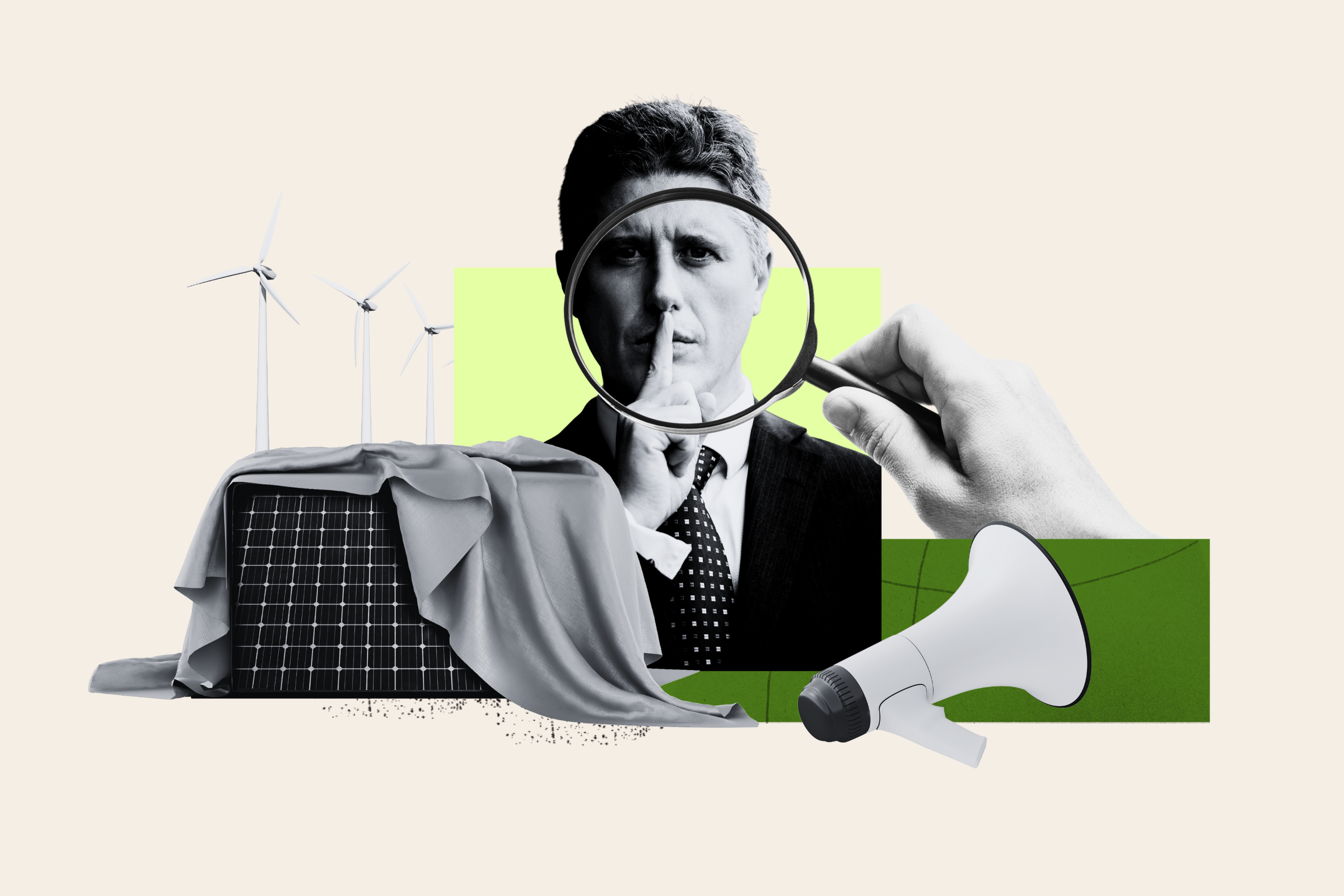
Climate change has gained intensity with record-breaking global temperatures and extreme weather, but it has lost ground in business communications.
Corporate reports and earnings calls now include fewer references to climate change and even many companies still pursuing net-zero goals are less vocal about their sustainability practices.
The phenomenon called greenhushing started amid the pushback against ESG, or environmental, social and governance (ESG) business practices, and has accelerated under the Trump administration’s efforts to roll back climate regulation.
But a number of experts in marketing and business sustainability argue that companies are making a mistake by staying mum on their climate action.
“CEOs should feel confident that climate change does not alienate their investors, customers or employees,” John Marshall, CEO and founder of the Potential Energy Coalition, told Newsweek.
Newsweek Illustration/Getty Images
Marshall calls Potential Energy a “marketing firm for the planet.” He takes his experience in marketing research and applies it to better understand consumer attitudes and craft effective messages on climate change.
Marshall said his work with surveys and focus groups tells him that while the political environment around climate change and sustainability has changed dramatically, “the citizen environment hasn’t really changed much at all.” Most ordinary people, he said, still hold the same, largely positive opinions of companies that take steps to address climate change.
“It might be polarizing in state houses and capitals, but it’s not polarizing around kitchen tables,” Marshall said. “The actual humans out there who are investors, employees and customers are seeing it the same way.”
Marshall, who is presenting his information at sessions during Climate Week NYC this week, is fond of saying that he doesn’t have opinions, he has data. And he said the data shows him something very different from the common perception that people are battling over climate beliefs.
“The data is that there’s a lot of concerned citizens, some are more informed about the issue, and some are less informed about the issue,” he said. “But they all get more supportive when they’re more informed about the issue.”
The takeaway for businesses, Marshall argued, is that more communication about their climate goals is better.
“If you talk to somebody about climate, you generally increase support for your message and support for your brand,” he said.
Professor Tensie Whelan is founding director of the NYU Stern Center for Sustainable Business, where her research focuses on the business benefits of sustainability.
“Companies need to be careful how they talk about sustainability—it needs to be authentic—but they should not be greenhushing,” Whelan told Newsweek.
Whelan said she has found that across industry sectors, sustainability drives better management through improved operational efficiency and risk management while building customer loyalty and employee retention.
By tracking consumer purchasing over the past ten years, she has found that products marketed with a sustainability message gained market share faster than conventionally marketed ones. Conventional brands, Whelan said, are suffering “the cost of inaction of not making claims around sustainability of the products.”
Strong environmental messaging is especially important internationally, Whelan said, where consumer attitudes in the E.U. and important emerging markets show higher levels of interest in sustainable business.
“If you operate in any kind of a global context you need to continue to be taking leadership on this,” Whelan said.
Mandi McReynolds is chief sustainability officer and vice president of external affairs for Workiva, a software company that offers a cloud-based platform to assist businesses with data reporting and regulatory compliance.
McReynolds said part of the greenhushing phenomenon is tied to companies looking for better ways to pull together finance, risk and sustainability.
“It’s not about the hushing, it’s about the amplification of those three factors coming together,” McReynolds told Newsweek.
She said that integration is especially important to investors who use a business’s sustainability goals and performance as indicators of that company’s ability to seize opportunities and minimize risks.
“They look for that data to see, ‘is this going to be a resilient business?'” she said. “If you’re not talking about it, you’re not providing your investors with the information they need.”
McReynolds described an approach to sustainability that has less to do with lofty public goals and more about making sustainability drive business performance.
Marshall echoed that idea and said that a business’s public messaging on sustainability should be rooted in business operations.
“Our strategy on climate messaging is that it needs to move from what we call morality to materiality,” Marshall said.
One outcome of the greenhushing phenomenon could be that those companies that continue to be vocal on climate action will have a stronger message, Whelan said.
“The silver lining here is that they will go back to fundamentals,” Whelan said. “That this is good management and good financial value and that is the way they should speak.”
